The most stationary of all stationery items, scissors hate to be hurried. I learned this as a child. You did too, probably. Don't run with scissors. A clear and simple instruction. Pencils, glue, staples... no problem. For them, like us, it's a finite existence. Time is short so don't dilly dally. But don't run with scissors.

Tuesday, 5 July 2011

klout, klout, let it all out

Influence comes in many guises. As a child you will have been influenced by those that raise you – parents, guardians, teachers and so on. When you grow a little older your friends become the biggest influence on you, and in later life influence can come from your colleagues, the people you manage, your partner. The list goes well beyond that, of course.

By and large, we all know who we are influenced by and to what extent. At least in the realm of the personal.

But identifying who wields influence has lately become a hot topic of considerable proportions in marketing, PR and comms teams the world over. As with most things in life, where there is demand there will surely be supply, and consequently there’s no shortage of people who want to appear to have influence and a growing trade in tools to tell you who has it.

The art critic and columnist Brian Sewell, when asked to comment on class and the English preoccupation with it, said: “You can acquire the trappings, but you can’t buy it.”

Can the same be said of influence? Well, yes and no.

The thing about being influential is that in the main either you are or you’re not. People will read what you write, listen to what you say and click the links you post because they trust you. This is influence.

There’s a whole chapter of a reference book that could be written on paid-for influence, but that’s not what I am concerning myself with here.

If people don’t respond in any of those ways, then – by definition – you lack influence.

However, there are plenty of things you can do to influence the way in which your own influence (can you see what I did there..?) is measured and scored by the likes of Klout, PeerIndex and TweetGrader. Most of these services will even give you tips on how to do it, with some of my favourites coming from PeerIndex who, essentially, advise you to be a person of influence if you want to have a higher rating on PeerIndex. Hard to argue with that logic.

But if you’re after shortcuts to a higher ranking there are a few quick and simple steps you can take. Here are three things you could consider.

  • Take a look at who you are following on Twitter, and have a bit of a clear out. Get rid of dormant accounts, bots, spammers and the like. While your follower numbers will go toward the score you achieve, the quality of those followers and your level of engagement with them is actually far more important.
  • If you are genuinely trying to cultivate an image as an influencer, have some focus. Decide what it is you are trying to be perceived as an expert in and cut your cloth accordingly in terms of the content you create and share as well the kinds of people you share it with. But don’t fall into the trap of creating a social media walled garden. If your tweets, and other content, are only picked up by your colleagues you will never achieve any meaningful amplification and your social media echo will be exactly that – just an echo.
  • Tweet often, but not too often. Sorry, you’re on your own as far as working out what on earth that might mean in terms of actual frequency. But clearly spamming the Bejebus out of everyone is more likely to cost you followers in the longer term, while letting the cobwebs settle won’t help your cause much either.


Having seen my own Klout score leap by almost 20 points since early June I feel pretty confident that some of this works. Even if I’m not entirely sure I know what I mean by “works” in this context.

I’m not advocating any kind of obsession with one’s online influence score. But the issue of who wields influence online isn’t likely to go away soon, so why not take an interest in the factors that determine the way in which others perceive how influential you are, and the part you can play in it.


Thursday, 30 June 2011

democracy, disintermediation & dining out at the all-day information buffet

Remember when you watched the TV news in the evening to hear about important stuff for the first time?

Remember when you read a newspaper in the morning so that you would feel informed of the weighty matters of the day?

I’ll bet neither of those things has happened to you for a while.

In pretty much every aspect of modern life, not just when it comes to the news, relationships between the public and the various providers of services and information have changed irrevocably.

You can call it disintermediation.

You can call it the democratisation of the means of publishing.

You can talk about citizen journalists if you really feel you need to.

But those of us who have regular contact with the internet no longer get our news in the old-school manner. Instead we use our RSS subscriptions, lists on twitter, messages via Facebook and other social media platforms and news websites to get our daily feed of news.

And we graze. A lot.

We take a mouthful of twitter-gossip, a bite of bloggetry, and chew on the wares of our favourite news sites. From this we get our fill of news.

Don’t get me wrong, there’s still a very important role for broadcast news and newspapers. But they’re rarely the first place you get to hear about something.

A growing number of people create content as well as consume it – blogs and tweets are some of the most obvious mechanisms for so doing, but there are others.

Ordinary people, for want of a less pejorative way of putting it, are now right in the centre of the flow of news and information, and are no longer reliant upon the traditional methods of staying informed. This is a trend (dare I even say phenomenon) that can be witnessed elsewhere.

How often does seeing one advertisement inspire you to go out and buy the product concerned?

Not often I imagine.

Would you buy something because a brand you like (or even “like”) is on Facebook? Again, probably not just off the back of that one thing, I expect.

Tweets, likes, reviews on blogs as well as in magazines (and their online variants), personal recommendations and so on, all go toward helping us make what we feel are informed choices about the goods and services we buy, and the ones we avoid. A lot of that information doesn’t come from what might be considered traditional sources, but is user-generated in the main.

Mobile phone companies are experiencing something similar. Do you feel much allegiance to your network provider? Despite statistics I’ve seen from research done by one of my clients (which indicates that two-thirds of us have been on the same network for at least three years) the likes of O2 and Vodafone can only dream of enjoying the kind of brand-kudos many of the handset makers revel in – Apple, BlackBerry, SonyEricsson for example.

It doesn’t stop there. The growing use of data-based services on smartphones, some of which will let you make VoIP calls (via 3G or wi-fi) effectively bypassing the carrier’s voice network completely, is another headache. People don’t get excited about the network they’re on – unless it stops working. The network has been usurped in people’s hearts by the app makers and handset manufacturers.

The common thread in all of this is that the old order is no more.

If your job involves managing customer relationships, or sales, or marketing, you ignore this at your peril.

If customers don’t see any perceived value in dealing with you they will simply ignore you and direct their attention to those people and organisations they feel an affinity for.

The challenge then is how to be valued in what is an undeniably information-rich world where there is no shortage of voices clamouring to be listened to.

You need to be present wherever your customers may be – and in every format they will be coming into contact with. You need to present a human face and treat people with the same respect that you would like to be treated with yourself.

Ultimately you want to be trusted and believable.

And it’s not rocket science, which makes it all the more noticeable when brands get it wrong.

Sunday, 8 May 2011

go ugly early


Rowan Williams, the Archbishop of Canterbury, is uncomfortable.  The killing of Osama Bin Laden prompted this revelation from the man-of-the-cloth’s man-of-the-cloth.  But more particularly, he was referring to certain inconsistencies in the story regarding that killing; at first the White House told the world Bin Laden was armed, then that he was unarmed.

Dr Williams’ reaction to this, as quoted by the BBC, was: "I think the killing of an unarmed man is always going to leave a very uncomfortable feeling because it doesn't look as if justice is seen to be done.  In those circumstances I think it's also true that the different versions of events that have emerged in recent days have not done a great deal to help.”

Getting to the heart of the matter quickly and being able to determine, often amid a great deal of confusion, the right course of action, is not easy and it’s not something everyone can do.  It’s a rare chance for someone in PR to tell the top brass to sit quietly and pay attention.

I can’t be the only person who has always thought the White House and the Pentagon would be stuffed to the rafters with the keenest minds in the comms world.

It’s easy to understand the difficulties in getting reliable information out of a combat zone.  Life-or-death split-second decisions don’t leave much scope for a thorough assessment of a situation before events start to take over, and in the aftermath it can take time to gather information, hear the accounts of the military personnel that were involved and so on.

Which is why the later version of the story released by the White House is the one we should, probably, put more faith in.

But it begs a question – why release the story at all before verifiable information had been received?

There was a lot said in the aftermath of Bin Laden’s demise about Twitter having broken the news.  A friend of mine said something to this effect… I may have read about Bin Laden’s death first on Twitter but I went to the TV news for verification.

After all, how many fake deaths have been ‘announced’ in 140 characters or less?

The title of this piece, go ugly early, is a phrase relayed to me by someone I know who was in the US Army in Afghanistan, as part of the comms team.  He was alluding to a principle that applies in crisis comms generally… get the story out first – before anyone else does – and stay in control of the message.

However unreliable the millions of sources on Twitter may be, its capacity for dissemination remains.  One of the consequences is that for someone in my line of work, whether in Windsor or the White House, you have to assume that someone somewhere knows something and if you don’t go ugly early they might. 

Saturday, 7 May 2011

loneliness and the late night vocalist

I've never really written much about my band, The Subtitles, on here.

We rehearse most Tuesday evenings between 9pm and 11:30pm.

Each night driving back from rehearsing - in recent weeks anyway - I've passed a woman who always arrests my attention.

I often seem to encounter a red traffic light at a particular junction. And she is always there.

She is what, when I was a boy, would have been called a tramp. Although there's something about her that makes me think she isn't actually homeless in the classic meaning of that word.

But home is more than just bricks and mortar, a roof over your head.

Probably in her mid-to-late 60s, painfully thin, with very long straggly grey hair and bedraggled clothes, she looks to be about six feet tall. And almost not-of-this-time. Or even this world.

On each of the occasions I've seen her she has been scrutinising the houses for sale displayed in an estate agent's shop windows.

She seems as fascinated by them as I have become by her.

Agitatedly rushing from one window to the other, she looks intently at the houses advertised and seems to be comparing the details of each as she stalks the shop front.

Why is she doing this? What is her story? I am filled with an urge to leave my car, get out and talk to her. Who knows, maybe one day I will. But I haven't yet.

The most I've seen her carrying is a bag of shopping, bought at a near-by late-night convenience store. Which is the main reason I think she lives somewhere, has a roof over her head, bricks and mortar that surround her.

But is that her 'home' I wonder.

Is it a place where she is surrounded by love and warmth, a sanctuary from the obstacles life has put in her path? Does it contain family, or a loved-one? Memories of what was. Regrets over what was not. Is she lonely? Or maybe just alone.

Does she look at the houses for sale and wonder about the lives people lead when they make them their home?

Then, inevitably, the traffic lights change. And I continue my journey home.


- Posted using BlogPress from my iPad

Tuesday, 3 May 2011

bonfire of the profanities


Swearing. It’s not big, it’s not clever, and it’s not funny. That’s what I was always told anyway.

Plainly two out of three of those are open to debate. We’ve all heard people use uncouth language in ways that were both clever and funny. In some cases, hilariously funny.

By and large though those occasions have probably involved listening to a friend regaling a group of mates with a funny story, or maybe while watching a stand-up comedian deliver their set.

It’s rare (although it can happen) that a complete stranger swearing in public will be anything like as funny.  Often it can be embarrassing.  And if there are small children or seniors within earshot it can be very uncomfortable.

We all know this. It’s not news. And while you’re welcome to disagree with me I’m most likely going to dismiss you as some sort of gauche moron. But that’s as much to do with me as it is with you.

Anyway... back to swearing, everything’s different online though, isn’t it?

No, not really.

Maybe it’s because my first encounter with the internet was 20 years ago that for me the distinctions between the virtual and 3D worlds are more subtle.

Maybe not. Frankly I don’t care. Let’s face it, neither do you.

Most of the people I’ve encountered on twitter over the last couple of years are unlikely to be the kind of person to start dropping the f-bomb should they be invited around to someone’s house for dinner, let’s say.

So why is it, I sometimes wonder, so many people (and more often than not it’s blokes) think it’s ok to swear online in a manner that is not attempting to be either clever or funny?  What’s their motivation?

I can only assume they are trying to look big.

They end up though looking immature, sounding offensive and losing credibility in front of people who can only form opinions of them based on what they see on screen.

So, next time you feel like telling your 450 followers that all the people in the supermarket checkout queue you're standing in are c-words, remember we’re all nodding in the kind of agreement you perhaps weren’t banking on.

Saturday, 30 April 2011

let love be genuine. abhor what is evil; hold fast to what is good

The build-up to the royal wedding, all the hype and expectation, left me fairly cold.

I don’t have a problem with the institution of marriage, nor with the monarchy per se. But the fuss that takes place on the periphery is, for me, a massive disincentive to pay much attention.

So it was that, after weeks or even months of taking little or no notice, I found myself instinctively sitting in front of the TV on the morning of Friday 29 April to watch the proceedings.

I know I am not the only person who reminisced about the wedding of Prince Charles and Lady Diana, as she was known back then in 1981. Similarly, I’m not the only person who reflected upon their own wedding day while watching the spectacle of two young people full of love and hope becoming husband and wife.

The 1981 royal wedding was the point at which my mother decided we were through with watching the world in black and white, and we got our first colour TV. For us, it was a pretty big deal. Although I don’t recall watching very much – if anything – of that royal wedding.

I guess it’s fairer to say it was a big deal for my mum.

Roughly mid-way between that royal wedding and the one that just took place, I got married.

My mother didn’t get to see it. She had died just less than a year prior to the occasion.

So it was that, as I sat listening to the readings and homilies at the wedding of Prince William and Kate Middleton, I thought about love, and hope and expectation. I thought about life and it’s uncanny knack of paying no attention to the plans we make. The people we become as we grow older are not the people we once were. We are changed by the lives we lead, the highs and the lows, the cards we are dealt by fate.

The joys and the disappointments.

If you have never found yourself wondering, in the face of a mountainous set-back, what the point of it all is, whether you have the strength to carry on, or why you foolishly made the decisions that led to the point you’re at, well you simply haven’t lived.

When children are very young they fall over – a lot. Parents watch anxiously to see if they are hurt, or if they will start crying, and there is always lots of encouragement not to cry, not to dwell on what just happened.

As we get older we forget how easy it is to fall over.

Failure, I read very recently, is a better teacher than success.

But it’s up to us to pay attention and learn from the lessons it delivers.


- Posted using BlogPress from my iPad

Wednesday, 27 April 2011

the revolution will not be televised

The revolution will not be televised. That’s what Gil Scott-Heron told us in 1970. And if that’s news to you, if that’s a piece of music you are not familiar with, then take a few minutes to click on this link and listen.

Then come back.

No, the revolution will not – in all likelihood – be televised.

Not that I am someone who blindly supports insurrection or feels that “the people” (whoever they may be) are somehow owed something by someone. I don’t condone violence, nor do I believe that simply rejecting the status quo will deliver a better future.

But I can’t be the only person in the UK who feels that something somewhere has gone wrong with the country I live in and call home.

This startling/not-so-startling insight came to me recently (last week to be more precise) in the most unlikely of settings…. while watching MasterChef – the UK flavour.

In the episode I watched four contestants were making tea for Henrietta the Dowager Duchess of Bedford, her son and his wife – the current Duke and Duchess.

According to the Sunday Times, the Duke was worth almost £500 million in 2005, making him the 102nd richest man in the country.

So, there I sat watching a show on a TV channel which is – by and large – funded by the TV-watching licence-paying public along with government subsidies, where one of the most privileged families in the country in their fabulous, inherited, stately home sampled a succession of High Tea offerings.

The same episode of MasterChef featured ex-service men and women from the Royal Air Force who served in World War Two. And as I wrote this, on ANZAC Day – when the sacrifices of the failed Gallipoli campaign of April/May 1915 are remembered – my thoughts turned to those generations that gave so much. In too many cases, they gave everything they possibly could; around 22,000 British servicemen died during that campaign.

Lloyd George promised the soldiers, sailors and airmen of the First World War a country fit for heroes. The post World War Two government set about building a network of social structures designed to bring about a greater degree of equality.

Those hopes, those dreams, the sacrifices of the fallen feel to me to be horribly at odds with the increasing inequalities of UK society that I see in 2011. According to a presentation given just a few weeks ago at the University of Cambridge, the rate of social mobility in Britain is slower now than it was in the Middle Ages.

If this is true, and far be it from me to pick a fight with the University of Cambridge, where is the incentive to work hard, do well and try to progress in a country where you are less likely to improve your lot than your ancestors 600 years ago?

Whether it's law, medicine or politics, the most influential and prestigious professions in the UK remain dominated by the tiny proportion of the population that received an expensive private education. 
Access to the top professions is probably as good an indicator of social mobility as anything else. 


I don’t want to live in a country where ne’er-do-wells get by comfortably thanks to state handouts. But nor do I want to live in a country where the descendents of a feudal elite continue to enjoy a super-rich lifestyle not because of their efforts, endeavours or enterprise, but because of a quirk of fate.  Where the sons & daughters of top professionals automatically follow in their parents' footsteps, first to fee-paying prep school, then to top-flight public school (if you're reading this from outside the UK 'public' in this context actually means private and fee-paying), then to a good university and so the cycle repeats.

The current generation of young Britons, graduates entering the workplace, could be – according to some estimates – the first that will not, en masse, enjoy a higher standard of living than the generation before it.

These are the same graduates that are leaving university with debts of as much as £30,000, at a time when unemployment is as high as it’s been for 15 years and when stringent government cutbacks have seen some towns and cities slash their spending on public services by 50 per cent or more. Public libraries are closing, museum opening hours are being restricted, and the provision of social care to “at risk” families and children is more precarious now than it has been since 1945.

Meanwhile, the cost of policing and security for the wedding of Prince William and Kate Middleton on 29 April is estimated to be in the region of £20 million.

No, the revolution will not be televised.

But that’s ok, the Royal Wedding will be
.


Friday, 22 April 2011

of statues, castles and spooky apparitions

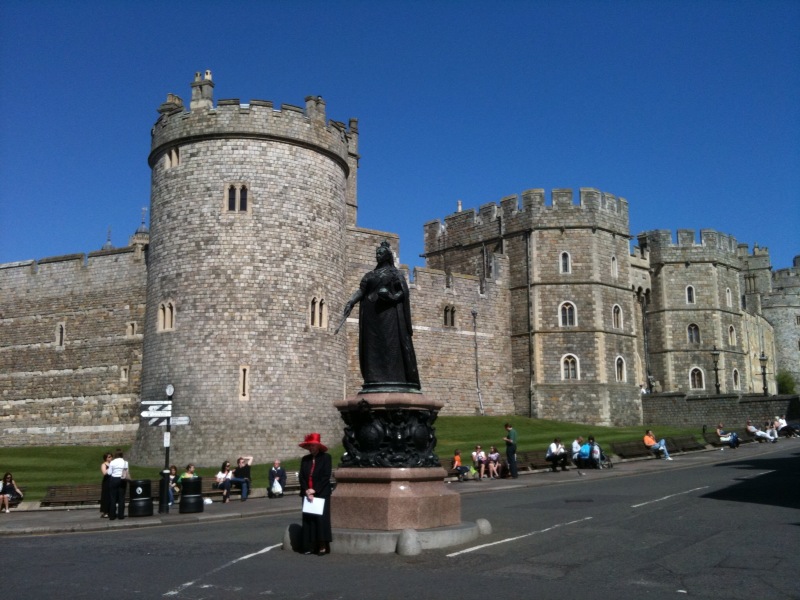
I took this photo on 8 April 2011. It shows the statue of Queen Victoria, with Windsor Castle in the background.

It's a popular choice for tourists taking photos of their visit to Windsor. I was on my lunchbreak and - struck by how blue the sky was, and the lack of people in the vicinity - I decided to take some pics.

It was some hours later when I looked at them again, and when I looked I saw something that quite literally made the hairs on my arms stand on end and my scalp tingle.

And not in a good way.


I was standing partly in the road to take that shot.


In the next one you can see how close I am to the statue - right next to it.

I decided to move close up to the statue, as I'd been standing in the road to take the two previous pics and a car was coming toward me. I stood next to the statue looking at it from a few different angles before taking this shot. When the car had gone I walked back across the road, pausing to take one final shot.


In the final pic you can see the figure of a woman standing next to the statue.

She is dressed in a rather unusual, striking manner. The kind of figure I think most people would agree you would notice. Especially if they were stood right in front of you.


I can't make you believe what I'm about to write. But when I looked at that pic, a few hours after I had taken it, one thought - and only one thought - ran through my mind... she wasn't there when I took that photo.

I would have noticed.

One of the reasons I took those pics is that it is rare to see the statue without people milling around it. The time that elapsed between the close-up and the final shot is literally seconds. Seconds after I had been standing next to the statue examining different angles for an interesting shot.

Surely I would have noticed if there had been someone there.

And how could I have failed to notice someone dressed like that?

Did it freak me out? Yes.

Spook me, put the wind up, give me the heebeegeebees? Yes. Yes. Yes.

Perhaps because I still feel sure she wasn't there when I took the photo. And perhaps because the figure in the photo bears more than a passing resemblance to my mother.

Saturday, 16 April 2011

my mother springs to mind


Spring.

The season of renewal – life, love and happiness.

What does it mean to you? Warm weather for the first time in months. Blossom on the trees. Lambs. Flowers. Easter. Mother’s Day.

A few years ago, while sorting through a box of papers and family memorabilia, I found two cards I had made for my mother when I was perhaps six or seven years old. One was a Mother’s Day card, the other an Easter card.

Both hand-drawn with bits of coloured paper stuck on them, and containing messages written in a small boy’s scrawly handwriting.

My mother died in late spring 1997 and it was a few years after that event that I found these cards – I had no idea she had kept anything from my childhood.

It was, unsurprisingly, an emotional moment for me.

This time of year has been tinged with sadness since my mother’s death.

I think about her a lot. But more so at this time of year, as the anniversary of her death approaches. Typically I get a withdrawn and introspective. Things that shouldn’t bother me do. Things that should interest me don’t.

It’s been the same every year since 1998. But it took me a while to realise what was happening. To spot the pattern.

This year will be no different. Is no different, in truth.

With one not-so-small exception. I haven’t typically acknowledged it, nor mentioned it to anyone. Instead I’ve just kind of bumbled through until the feeling has left me, snapping at and alienating people along the way.

Not this year.

If you’ve read this far you’ll know what’s eating me next time you find yourself thinking “what’s eating him?

And I’ll know it’ll be a lot easier on everyone if I face up to it and deal with it, rather than let it dictate how I feel for a couple of difficult weeks.

Life, love and happiness might be a bit of a stretch. But a season of renewal..? I’ll give that a go.

Monday, 11 April 2011

do we have the press we deserve?

Updated 5 July 2011

On 4 July it emerged that the News of the World had done far worse than hack into the voicemail inboxes of celebrities and politicians. Someone working for the paper had accessed the inbox of the then missing teenager Milly Dowler. At some point between Milly's disappearance and the discovery of her dead body, voicemails from her phone were deleted. This act, we are told, caused her parents - who had no doubt been franticly calling her but unable to leave further messages at a full inbox, to believe she was still alive.


This depraved act has, thankfully, been taken seriously by Parliament - the whole sordid affair will be debated by the House of Commons on 6 July.


There has already been a considerable public backlash against the News of the World, with calls for advertisers to pull out their commercial support for the paper. Some have already indicated they will indeed take such action.


I am sure I speak for most people when I say I sincerely hope the perpetrators of this criminal and morally bankrupt behaviour are subject to the full weight of the law.


I can't help but wonder, however, when similar scrutiny will fall upon the role of the Metropolitan Police and the widespread speculation concerning their collusion in the mobile phone hacking scandal.


The British press has a fearsome reputation both at home and abroad. It’s one of the reasons so many former UK journalists find high-powered jobs as corporate communications advisers to some of the biggest names worldwide.

Investigative journalism at its best has brought down tyrants, exposed fraudsters, and highlighted miscarriages of justice. It is no coincidence that in some of the most locked-down regimes there are more constraints upon what the press can effectively get away with. Indeed, the freedom of the press is one of those concepts clung to fiercely by many in this country.

Rightly so, in my opinion.

But – as anyone who has read the British press widely in the last 15 years will know – the excesses of the tabloid media have caused many a raised eyebrow.

From Fake Sheikhs to allegations of Nazi-themed sex parties there has been an unending stream of sensational stories to titillate and tantalise. Many seem to blur the lines between that which is in the public interest and those things that are deemed to be of interest to members of the newspaper-buying public.

As a former journalist, I have enjoyed the freedom to ask challenging questions and to protect my sources. I’ve had libel writs served on me, and even death threats. OK, just one death threat – but one is enough. I never felt I had to curtail my journalistic instincts in order to kowtow to the whims of publishers, advertisers, the police, the subjects of the pieces I wrote, anyone in fact.

When I hear people complain about the “rubbish that gets printed in the papers” my standard response has usually been to say we get the press we deserve and to make the point that the so-called rubbish only gets published because people flock to read it.

Shady goings on behind the scenes at some of the UK biggest newspapers have now begun to be dragged into the light in the wake of the News of the World phone hacking scandal (not a word I use lightly, but one which I think fits here).

The ins and outs of who knew what, and who sanctioned the illegal actions – namely hacking into voicemail messages on the mobile phones of a string of celebrities, politicians, civil servants and other public figures – is still the subject of debate and investigation. But some of the details to emerge are as damning of the culture of the UK media as they are downright shocking.

Top of my list of things to be concerned about is the link between News of the World reporters and the Metropolitan Police. I offer here only my opinion, but having heard that Metropolitan Police officers were paid sources for some News of the World reporters (how many news reporters wouldn’t like to be tipped off about high profile arrests, so they could be on hand to cover them) I start to feel a growing sense of unease.

You don’t need to be a genius to figure out the incredible potential for a conflict of interests when a newspaper allegedly encouraging its reporters to break the law is also regularly paying serving police officers for news leads. Throw into the mix the claim by a former senior officer in the Metropolitan Police, Brian Paddick, that his phone had been hacked into by the News of the World and the whole thing starts to feel very grubby indeed.

It’s unpleasantly reminiscent of the script of a movie, where the mob has paid off the police to ensure a blind eye is always turned to their criminal activity.

Now that the lid has been blown off this miserable affair, I’m left asking myself do we get the press we deserve?

I worry this is more than an isolated case of a newspaper’s ethics being trampled in the rush to boost sales in the midsts of a highly competitive media landscape.

This is, I fear, as much a wider dereliction of societal morality - an attitude of if I can get away with it, then I’m going to do it.

In October 1987, in an interview with one of the least combative publications imaginable, Woman’s Own, the then Prime Minister Margaret Thatcher said: “... who is society? There is no such thing as society. There are individual men and women, and there are families.”

Clearly this is nonsense. Dangerous nonsense though, which set the tone for the next two decades and beyond.

The promotion of the individual, and their so-called rights, that took place in this country and in others (yes America I am looking at you) has spawned a generation of individuals who simply don’t care about the implications, or even the legality, of their actions.

That there were journalists working for the most widely-read British Sunday newspaper who felt breaking the law was an acceptable route to scoops and stories is, for me, an indication that the UK's moral compass may be broken.

Do we have the press we deserve?

Yes, we do.

And that is a reputation to be feared.


- Posted using BlogPress from my iPad