The most stationary of all stationery items, scissors hate to be hurried. I learned this as a child. You did too, probably. Don't run with scissors. A clear and simple instruction. Pencils, glue, staples... no problem. For them, like us, it's a finite existence. Time is short so don't dilly dally. But don't run with scissors.

Friday, 22 April 2011

of statues, castles and spooky apparitions

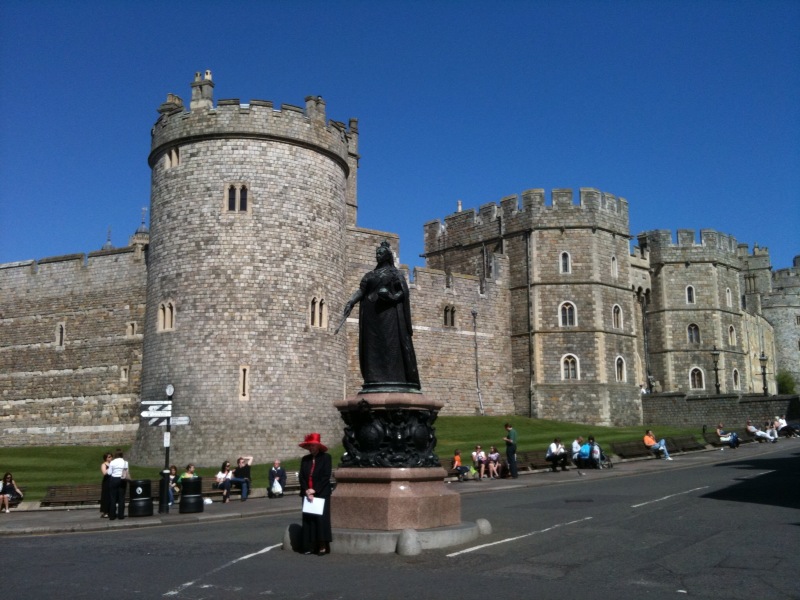
I took this photo on 8 April 2011. It shows the statue of Queen Victoria, with Windsor Castle in the background.

It's a popular choice for tourists taking photos of their visit to Windsor. I was on my lunchbreak and - struck by how blue the sky was, and the lack of people in the vicinity - I decided to take some pics.

It was some hours later when I looked at them again, and when I looked I saw something that quite literally made the hairs on my arms stand on end and my scalp tingle.

And not in a good way.


I was standing partly in the road to take that shot.


In the next one you can see how close I am to the statue - right next to it.

I decided to move close up to the statue, as I'd been standing in the road to take the two previous pics and a car was coming toward me. I stood next to the statue looking at it from a few different angles before taking this shot. When the car had gone I walked back across the road, pausing to take one final shot.


In the final pic you can see the figure of a woman standing next to the statue.

She is dressed in a rather unusual, striking manner. The kind of figure I think most people would agree you would notice. Especially if they were stood right in front of you.


I can't make you believe what I'm about to write. But when I looked at that pic, a few hours after I had taken it, one thought - and only one thought - ran through my mind... she wasn't there when I took that photo.

I would have noticed.

One of the reasons I took those pics is that it is rare to see the statue without people milling around it. The time that elapsed between the close-up and the final shot is literally seconds. Seconds after I had been standing next to the statue examining different angles for an interesting shot.

Surely I would have noticed if there had been someone there.

And how could I have failed to notice someone dressed like that?

Did it freak me out? Yes.

Spook me, put the wind up, give me the heebeegeebees? Yes. Yes. Yes.

Perhaps because I still feel sure she wasn't there when I took the photo. And perhaps because the figure in the photo bears more than a passing resemblance to my mother.

Saturday, 16 April 2011

my mother springs to mind


Spring.

The season of renewal – life, love and happiness.

What does it mean to you? Warm weather for the first time in months. Blossom on the trees. Lambs. Flowers. Easter. Mother’s Day.

A few years ago, while sorting through a box of papers and family memorabilia, I found two cards I had made for my mother when I was perhaps six or seven years old. One was a Mother’s Day card, the other an Easter card.

Both hand-drawn with bits of coloured paper stuck on them, and containing messages written in a small boy’s scrawly handwriting.

My mother died in late spring 1997 and it was a few years after that event that I found these cards – I had no idea she had kept anything from my childhood.

It was, unsurprisingly, an emotional moment for me.

This time of year has been tinged with sadness since my mother’s death.

I think about her a lot. But more so at this time of year, as the anniversary of her death approaches. Typically I get a withdrawn and introspective. Things that shouldn’t bother me do. Things that should interest me don’t.

It’s been the same every year since 1998. But it took me a while to realise what was happening. To spot the pattern.

This year will be no different. Is no different, in truth.

With one not-so-small exception. I haven’t typically acknowledged it, nor mentioned it to anyone. Instead I’ve just kind of bumbled through until the feeling has left me, snapping at and alienating people along the way.

Not this year.

If you’ve read this far you’ll know what’s eating me next time you find yourself thinking “what’s eating him?”

And I’ll know it’ll be a lot easier on everyone if I face up to it and deal with it, rather than let it dictate how I feel for a couple of difficult weeks.

Life, love and happiness might be a bit of a stretch. But a season of renewal..? I’ll give that a go.

Monday, 11 April 2011

do we have the press we deserve?

Updated 5 July 2011

On 4 July it emerged that the News of the World had done far worse than hack into the voicemail inboxes of celebrities and politicians. Someone working for the paper had accessed the inbox of the then missing teenager Milly Dowler. At some point between Milly's disappearance and the discovery of her dead body, voicemails from her phone were deleted. This act, we are told, caused her parents - who had no doubt been franticly calling her but unable to leave further messages at a full inbox, to believe she was still alive.


This depraved act has, thankfully, been taken seriously by Parliament - the whole sordid affair will be debated by the House of Commons on 6 July.


There has already been a considerable public backlash against the News of the World, with calls for advertisers to pull out their commercial support for the paper. Some have already indicated they will indeed take such action.


I am sure I speak for most people when I say I sincerely hope the perpetrators of this criminal and morally bankrupt behaviour are subject to the full weight of the law.


I can't help but wonder, however, when similar scrutiny will fall upon the role of the Metropolitan Police and the widespread speculation concerning their collusion in the mobile phone hacking scandal.


The British press has a fearsome reputation both at home and abroad. It’s one of the reasons so many former UK journalists find high-powered jobs as corporate communications advisers to some of the biggest names worldwide.

Investigative journalism at its best has brought down tyrants, exposed fraudsters, and highlighted miscarriages of justice. It is no coincidence that in some of the most locked-down regimes there are more constraints upon what the press can effectively get away with. Indeed, the freedom of the press is one of those concepts clung to fiercely by many in this country.

Rightly so, in my opinion.

But – as anyone who has read the British press widely in the last 15 years will know – the excesses of the tabloid media have caused many a raised eyebrow.

From Fake Sheikhs to allegations of Nazi-themed sex parties there has been an unending stream of sensational stories to titillate and tantalise. Many seem to blur the lines between that which is in the public interest and those things that are deemed to be of interest to members of the newspaper-buying public.

As a former journalist, I have enjoyed the freedom to ask challenging questions and to protect my sources. I’ve had libel writs served on me, and even death threats. OK, just one death threat – but one is enough. I never felt I had to curtail my journalistic instincts in order to kowtow to the whims of publishers, advertisers, the police, the subjects of the pieces I wrote, anyone in fact.

When I hear people complain about the “rubbish that gets printed in the papers” my standard response has usually been to say we get the press we deserve and to make the point that the so-called rubbish only gets published because people flock to read it.

Shady goings on behind the scenes at some of the UK biggest newspapers have now begun to be dragged into the light in the wake of the News of the World phone hacking scandal (not a word I use lightly, but one which I think fits here).

The ins and outs of who knew what, and who sanctioned the illegal actions – namely hacking into voicemail messages on the mobile phones of a string of celebrities, politicians, civil servants and other public figures – is still the subject of debate and investigation. But some of the details to emerge are as damning of the culture of the UK media as they are downright shocking.

Top of my list of things to be concerned about is the link between News of the World reporters and the Metropolitan Police. I offer here only my opinion, but having heard that Metropolitan Police officers were paid sources for some News of the World reporters (how many news reporters wouldn’t like to be tipped off about high profile arrests, so they could be on hand to cover them) I start to feel a growing sense of unease.

You don’t need to be a genius to figure out the incredible potential for a conflict of interests when a newspaper allegedly encouraging its reporters to break the law is also regularly paying serving police officers for news leads. Throw into the mix the claim by a former senior officer in the Metropolitan Police, Brian Paddick, that his phone had been hacked into by the News of the World and the whole thing starts to feel very grubby indeed.

It’s unpleasantly reminiscent of the script of a movie, where the mob has paid off the police to ensure a blind eye is always turned to their criminal activity.

Now that the lid has been blown off this miserable affair, I’m left asking myself do we get the press we deserve?

I worry this is more than an isolated case of a newspaper’s ethics being trampled in the rush to boost sales in the midsts of a highly competitive media landscape.

This is, I fear, as much a wider dereliction of societal morality - an attitude of if I can get away with it, then I’m going to do it.

In October 1987, in an interview with one of the least combative publications imaginable, Woman’s Own, the then Prime Minister Margaret Thatcher said: “... who is society? There is no such thing as society. There are individual men and women, and there are families.”

Clearly this is nonsense. Dangerous nonsense though, which set the tone for the next two decades and beyond.

The promotion of the individual, and their so-called rights, that took place in this country and in others (yes America I am looking at you) has spawned a generation of individuals who simply don’t care about the implications, or even the legality, of their actions.

That there were journalists working for the most widely-read British Sunday newspaper who felt breaking the law was an acceptable route to scoops and stories is, for me, an indication that the UK's moral compass may be broken.

Do we have the press we deserve?

Yes, we do.

And that is a reputation to be feared.


- Posted using BlogPress from my iPad

Saturday, 2 April 2011

coming of age: if the shoe fits

For most of us there are particular points in life that seem to mark the passing of time. It could be turning 18, or 21. Or maybe 25 felt like a more significant age for you. For many, 30 is the point at which you begin to realise you’ve come a long way since school, college or university.

Beyond that there’s that old chestnut… the Big Four O, where – allegedly – life begins.

There are more subtle (and some not so subtle) ways in which the ageing process starts to hit home. Grey hairs, wrinkles, unexplained aches and pains, and so on.

However, if you haven’t got to it yet, you may find the day you start to remind yourself of your parents is actually the point at which you say to yourself, “shit, I’m getting old!”

I think it’s especially common once you become a parent yourself. That’s certainly been the case for me.

It’s rare that I do something that reminds me of my late mother. But there are occasional reactions I’ll have to situations that make me think “that’s exactly what she would have said.”

Sadly, that’s almost never happened in a way that’s made me feel warm and fuzzy.

Like most men, though, it’s the war against turning into my father that keeps me busiest.

He would have been 86 years old today, but he died in January.  He left Ireland in the 1940s, volunteered for the RAF, fought in WWII, settled in Britain, raised a family, and was a manual worker all his life. He wasn’t very well-educated, but he was sharp and had a quick sense of humour. He had a very tough childhood and was one of the hardest men I’ve ever met.

In the last five or six years of his life, I didn’t see much of him. I would get reports on his health and well-being from my siblings, who often lamented that he was losing his grip a little.

It brought to mind something that happened when I was a young boy – my dad would have been in his early 50s I guess.

We lived in Birmingham and despite the fact that during the war he was a driver (among other things) my dad never bought a car – we went everywhere by bus and train.

And so it was one Saturday morning that he, my mother and I set off for Birmingham city centre on some shopping excursion or other.

We walked the 10 minutes or so to the bus stop and waited. We hadn’t been there long when, in that heavy Dublin accent that he had somehow steadfastly held onto, my dad declared, “oh Christ, would you look at that.”

We followed his gaze and looked down at the ground. He’d left home wearing one black shoe and one brown one. “I wondered why one foot was going tap and the other was going shuffle,” he said.

He made his way back home to sort himself out, while my mother and I were consumed by uproarious laughter.

So, upon hearing my brother or my sister say they thought dad was losing his marbles, my reaction (which I accept to the outside world may seem unfeeling) was to say “he’s been like that for at least 35 years – it’s nothing new.”

Sometimes when I catch sight of myself in a full-length mirror I see my father for a split second out of the corner of my eye. For some reason it happens more if I’m wearing a suit – which I do frequently in my line of work, but he only ever did for weddings, christenings and funerals.

If I stare at my reflection in the shaving mirror long enough and then slowly squint, he appears there too.

And there have been times when I’ve raised my voice in anger only to hear his words coming out of my mouth rather than my own.

The black shoe / brown shoe incident came back to me only a couple of months ago and I started joining some of the dots around all of this and attempting to make sense of the picture that was forming – my relationship with my father, his influence over the man I have grown into, the way I relate to people and the world around me, the way I conduct myself.

For some reason – and this really has been going on for several months now – I’ve had a nagging doubt every now and again that I might, just maybe, have put odd shoes on.

I find myself staring at my feet (it tends to happen mostly when I’m in the car) to see if I’ve actually got a matching pair of shoes on.

I hadn’t connected it with anything. It doesn’t feel like deep in my subconscious there sits a latent fear that I will wear odd shoes just because my dad once did. In much the same way I’ve never thought it was likely I’d wake up one day to find I’d got a job as a scaffolder.

If it’s done anything, maybe it’s made me consider that I’m more like him than I realise 
– or am prepared to admit. I can accept that I’m like him in many externalised ways: short-fuse, gregarious in the right company, sentimental, musical.

But I’ve never given much thought to what life must have been like inside his head.

Perhaps it was much the same for him as it is for me.

If I’m one step away from anything as a result of all this, perhaps it’s not a footwear faux pas, but an appreciation of the man I spent so many years utterly convinced I would never understand.


Thursday, 31 March 2011

like a virgin

I recently visited Australia. I flew with Virgin Atlantic.

Yesterday I talked with a colleague who had been to Kuala Lumpur – different airline, I’m not going to name them here. Some other time maybe.

But the conversation made me consider my experience with Virgin Atlantic in a new light.

Last time I flew with Virgin I ended up writing to their customer service people to praise the way in which a member of the cabin crew had coped with a disruptive passenger.

This time, nothing happened. So, unsurprisingly, I didn’t feel the need to write to anyone.

But what I’ve come to realise in the last day or two is that nothing happening can sometimes be a very good thing indeed.

Here’s a list of things that didn’t happen.

  • Virgin Atlantic didn’t change the plane at the last minute to an aircraft with fewer seats, leaving many passengers stranded for 24 hours
  • No one from Virgin Atlantic was rude
  • The plane was not delayed taking off
  • There were no problems with the transfer at Hong Kong
  • My luggage did not get lost
  • The food was not vile

You may be thinking, “but that’s the bare minimum anyone expects.” And you’d be right.

But it’s still more than a lot of people get from much larger airlines that have been operating for longer.

And just because it’s the bare minimum doesn’t mean we shouldn’t express gratitude.

So, thank you Virgin Atlantic. My flights to and from Sydney passed off completely incident free. Every one of your staff that I dealt with was polite and helpful. 


Monday, 28 March 2011

how do I get hyperlinks within blogger to open in a new window or tab?

Yesterday I wrote a piece about the use of Facebook to promote my band, The Subtitles.

That post included several links including a couple to The Subtitles on Facebook.

However, as I discovered (and it’s been pointed out to me too) those links don’t work properly.

I tested them before the post went live and they worked fine. But from within the post itself, the links to Facebook bring up a blank Facebook page with another link which has to be clicked on to bring up the right page.

Anyone got any ideas…?

Sunday, 27 March 2011

facebooking the music

As some of you reading this will know, I am currently the lead vocalist in a band called The Subtitles.

Most people agree it’s a cool name.

And when we launched it late last year, most people agreed we have a cool website.

We have a page on Facebook. And a Twitter account.  You might want to open those links in a new tab - for some reason that seems to work better.

But the website is easily our most impressive online estate. Lots of pics, some of which were sent in by people who attended our gig in February. There are also two recordings so you can get an idea of what we sound like.

Some people like how we sound, others… well not so much. But that’s ok, there’s no point trying to be all things to all people.  But I have high hopes of some of the news songs we're writing.

Anyway back to Facebook. I have a confession. I’ve always felt somewhat conflicted about using it where the band is concerned.

I was an early adopter of LinkedIn. I was on MySpace before it peaked, and then well, less-than-peaked.

And I took to Twitter with a zeal that would put many a religious fundamentalist to shame.

But when it comes to using Facebook to promote The Subtitles I keep hitting a wall. If you’ll pardon the pun.

So if you’ve read this far I would like crave your indulgence.

I'd like you to visit The Subtitle’s Facebook page and well… do something. Like it, share it, critique it, leave a comment here and tell me what you think about it.  Anything really - advice that I can use to improve things, that's what I'm looking for.

Thanks in advance – I hope to hear from you.

Saturday, 26 March 2011

top tips for journalists wanting to make it in pr

I’ve lost count of how many times someone has talked to me about the move I made from journalism into PR. My move to the dark side, which took place in late 2000.

I entered the heady world of journalism in the early 1990s, worked for contract publishers, several newspapers (regional and national) and magazines, tried my hand as a freelancer, went into the trade press and ended up as the managing editor on a news website which, during the two years I was there, grew its readership from 500,000 to more than six million.

The move to PR is a well-trodden path for journalists who have, for one reason or another, hit a wall and felt the need to do something different. In my case I wanted a new set of challenges, but didn’t want to have to start from scratch. Oh, and the money was a little better too – not hugely so.

There is no single reason why the move sometimes goes wrong (I don’t know what the failure rate is, but it must be pretty high). Typically fault lies both with the individual and the PR agency that has employed them.

A lot of emphasis is put on transferable skills, such as being able to write. If fact, far too often it goes no deeper than that combined with a hint of this’ll impress the client thinking.

The journo entering the PR workplace lacks a great deal of context of the mechanics of the job, the way an agency operates, the way a team works. That latter point is a good one, after all journalists are not, by nature, team players.

Customer service, appeasement and a can-do attitude also don’t necessarily come naturally to most hacks who have spent their careers marching to the beat of a very different drum.

My first ever client meeting after entering PR is something I will probably never forget. I’d been in my new role for a matter of days when I was sent to deal with a problem client.

The meeting lasted less than five minutes and concluded with a very red-faced and shouty client telling me that he was firing the agency I had just joined.

Culture shock…? You could call it that, yes.

So, here are my three top tips for anyone considering ditching their career in journalism to don a suit and join the PR party.

1. Get real
Be sure you know what you’re letting yourself in for.

You mustn’t assume that all your days will be filled with high-level strategic planning meetings, and long periods of crafting your finest prose.

How will you really feel pitching in a story to journalists? How will you cope when the features and press releases you have written are picked apart by people who will never be able to write as well as you but have the veto on what you produce?

2. Do your homework
Get the job spec, and find out what the responsibilities are. Meet the people you’ll be working with and managing – especially the ones you’ll be managing. Their careers are about to be put in the hands of someone with no PR experience. They may well be concerned about this. You need them onside.

Unlike a newsdesk, a PR account team has to work well and work together to get the best results. Be prepared to be supportive, nurturing and even nice to people.

3. Put on a happy face
Journalists earn their stripes by critiquing, by being sceptics – asking the difficult questions and highlighting problems and shortcomings.

Where they often fall down is coming up with positive solutions to the situations they have kicked holes in.
It’s easy to point out shortcomings, harder to put forward your own ideas for public scrutiny. But that’s what’s required.


It won’t be an easy ride. But nothing worth having was come by easily, was it?

If I had to include a fourth point it would be something like network – get out and talk to people.

But three’s a magic number so I shan’t bother with No 4.

Friday, 25 March 2011

Europe is dead

Europe is dead.


Or at any rate, the notion of a unified Europe is now in serious decline politically and economically.


Sovereign debt, bail-outs, and austerity measures have featured in the news for many months now but it is only very recently that some of the less obvious implications of these events have been discussed.


Let’s take the example of Portugal, the most recent European economy to come unstuck.


Like most countries, Portugal relies on borrowing and issuing bonds to keep the wheels of its domestic economy turning.


In April, Portugal has €5 billion of repayments to honour.  There’s a similar amount due to be repaid in a few months’ time.


To meet those commitments, particularly the second tranche, Portugal will – in all likelihood – need to borrow.  But as an economy in trouble, it is penalised by having higher rates of interest applied to its bonds.  IE: the markets want a higher rate of return in exchange for what is considered a higher risk loan.


That rate of interest is in the region of 8% over a period of 10 or so years.


The Portuguese economy will not grow at anything like that rate. Meaning that meeting its repayment responsibilities in the future will become increasingly harder.  Which in turn has to increase the likelihood of Portugal defaulting on its debts.


No problem, some will say… there are bail-out options.


Yes, there are. And they are mostly funded by Germany, the Netherlands and to a lesser extent France and Finland.


There is a growing sense of dissatisfaction within these countries, especially Germany, that the domestic tax-payer is bailing out their lazy southern European neighbours. Politically-speaking, this is an unsustainable situation and unless it has been dealt with before then, it will become a major issue at the next German general election.


There is a sense among some economists that as long as this situation is confined to Ireland, Greece and Portugal (smaller nations) the rest of Europe needn’t worry.


But should Spain or Italy, for example, succumb to the financial fallout the consequences would be harder to live with for Europe as a whole and could herald the end of the Euro.


No one seems to have any answers as to how any of this could be avoided or how Europe gets out of this situation. Ignoring it, however, won’t make it go away.

Sunday, 30 January 2011

Egypt, twitter and social media tools

I have been an active user of twitter for about two years. I’m no veteran or social media maven, but I’m no newbie either.


Twitter’s helped me find work and business opportunities. I’ve used it to find people to hire, I’ve even forged friendships with people I would never have met had it not been for twitter.


Depending on how you use it, it’s an interesting and useful tool, or a way of revealing your ignorance. But a hammer can be used to help you hang a picture of your grandmother on the wall, or as an offensive weapon. It's a tool.


Not for the first time in the last two years, I’ve recently found myself watching with a sense of mild bemusement as news of events thousands of miles away is broadcast via twitter along with a heady mix of opinion and speculation.


I am, of course, referring to Egypt. Political and societal turmoil – protests, demonstrations, and a death toll which rises daily.


As a former journalist, when something big like this happens I want to know about it: I want context and background, I want to question the sources of the information, I want to know how reliable they are.


The polarisation of the twitterati in such events as those unfolding in Egypt, is also interesting.


It doesn’t take long for people to decide there are Good Guys and Bad Guys and that somehow everyone involved, no matter how loosely, is affiliated with one side or another.


The other thing that really strikes me is the desire of many on twitter to broadcast every new, or not so new, detail in a manner that attributes equal weighting to everything, while simultaneously rushing to be the first to move the story on, so to speak.


Don’t get me wrong. Some of it has been well worth reading – such as the piece I read regarding the manner in which the lights went off across Egypt’s ISPs. But the majority of what’s appeared in my stream has tended toward being tub-thumping sloganeering.


I can only offer conjecture of my own when I wonder how many (by which I really mean “how few”) of the people I follow on twitter who are avidly tweeting and RT-ing Egypt-related information really have an understanding of what is going on there.


Yes, we all know the Mubarak government has been criticised for being oppressive and not committed to a meaningful democracy.


But what do we know of the forces within Egypt that have realised current events offer them a golden opportunity to exert influence, possibly even seize power and have the country march to the beat of their drum?


The answer is as obvious as it is depressing – very little.


The history books are full of accounts of popular uprisings and revolutions that before long were exploited by those with their own, sometimes deeply oppressive, agenda.


But reading history text books affords few opportunities to show off about how ‘aware’ one is.